Plan your next adventure with our Caravan Loan Repayment Calculator. Estimate repayments, view amortization charts, and compare finance options with ease.
Calculator results are estimates based on the inputs and assumptions used and are for general information only. They are not quotes, offers, approvals, eligibility decisions or personalised recommendations. Actual repayments and costs may differ.
Caravan Loan Details:
Important!
Caravan Loan Interest Rates differ from lender to lender and will depend on your individual circumstances (credit history, employment status, age, etc.).
Caravan Loan Amortisation Calculator
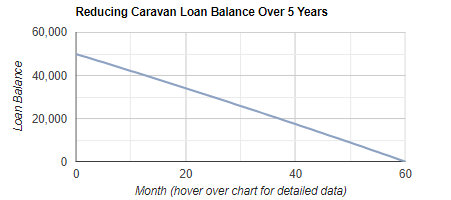
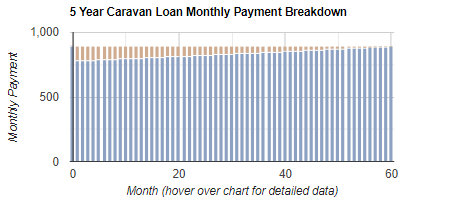
The following amortisation graphs detail month-by-month data on the progress of the proposed loan. The first chart below examines the reducing loan balance over the course of the finance contract term. The second graph illustrates the portion of each monthly repayment allocated to payment of interest vs principal reduction.
How to use our Caravan Loan Repayment Calculator
Our Caravan Loan Repayment Calculator helps you estimate your likely monthly caravan loan repayments, understand how much interest you may pay over time, and visualise your loan via amortisation charts. It’s important because small changes to your purchase price, deposit, loan term or interest rate can materially affect cash flow and the total cost of caravan finance, helping you plan a realistic budget before you apply.
How to complete the form for the best result
1. Purchase Price
Enter the full caravan purchase price you expect to finance. If you plan to roll costs into the loan, consider adding likely upfront expenses such as registration, insurance and other on-road costs (where applicable). Use whole numbers only (no decimals or commas) to match the calculator format.
2. Deposit or Trade-in Value (if applicable)
Add any cash deposit and/or the trade-in value of an existing caravan. If you have no deposit or trade-in, leave this field blank. A higher deposit generally reduces the amount borrowed and can lower repayments and total interest.
3. Term of Loan (years)
Select the number of years you want to repay over. Longer terms usually reduce monthly repayments but increase the overall cost of the loan due to more interest over time. Choose a term that fits your budget with a buffer for rate rises and living costs.
4. Interest Rate (percent per annum)
Select an interest rate to simulate. The listed range is indicative only and your actual rate can only be confirmed after you apply, based on factors like credit history and employment.
5. Calculate
Click calculate to generate your estimated repayment and amortisation charts.
How to interpret the results
1. Repayment estimate
Use the monthly repayment figure as a budgeting guide, then compare scenarios by adjusting the term, deposit and interest rate.
2. Amortisation charts
The loan balance chart shows how your debt reduces month by month. The interest versus principal chart highlights that early repayments typically include a higher interest portion, with more of each payment going to principal later in the term.
Important information (ASIC-style general guidance)
Results are estimates and do not constitute a quote. They may not include fees, charges, or lender-specific features. This information is general and does not consider your objectives, financial situation or needs. Consider whether a caravan loan is appropriate for you and seek personalised advice if required. Credit is subject to approval and terms and conditions.
If you're looking to buy your first home, starting to save early is one of the smartest financial moves you can make. By beginning to save when you're young, you give yourself a head start in accumulating the necessary funds to make a deposit on a house. This proactive approach has numerous benefits that extend beyond just having more money in the bank. - read more
Home loans in Australia involve more than choosing an interest rate. Borrowers need to understand deposits, borrowing capacity, repayments, fees, settlement and features such as offset accounts and redraw facilities before comparing options. - read more
Car loans can help Australians buy a new or used vehicle, but the structure of the finance matters. This guide explains secured and unsecured vehicle finance, repayments, balloon payments, fees, eligibility and key checks to make before applying. - read more
Australian lenders assess loan applications by looking at income, expenses, credit history, existing debts, security, documentation and whether the loan appears affordable for the borrower's circumstances. - read more
Financial hardship support is back in the spotlight across Australia’s lending market, with regulators and consumer advocates paying closer attention to how banks and non-bank lenders respond when borrowers ask for help. For households and small business owners already dealing with higher living costs, tax obligations, insurance premiums and uneven cash flow, this is more than a compliance story. It is a practical reminder that loan stress should be addressed before it becomes a missed-payment pattern. - read more
Fresh attention on Australian mortgage arrears is a reminder that repayment pressure is no longer just a theoretical risk for highly leveraged households. After a long period of elevated interest rates, higher insurance costs, bigger grocery bills and tighter household budgets, more borrowers are finding that even small financial setbacks can make loan commitments harder to manage. - read more
Refinancing is moving back into focus for Australian borrowers as households and small businesses look for ways to regain control over higher repayment commitments. Recent lending market updates suggest more borrowers are no longer simply waiting for broad interest rate relief; they are actively reviewing whether their existing loan still fits their income, expenses and longer-term plans. - read more
The latest home lending indicators point to a property finance market that is still moving, even with borrowers facing high living costs and careful lender scrutiny. Investor activity has been one of the stronger parts of the market, adding another layer of competition for owner-occupiers and first-home buyers trying to secure finance. - read more
Guarantor: A party who agrees to be responsible for the payment of another party's debts should the original party fail to pay or perform according to a contract.